1. Introduction
In the realm of higher education administration research, the topic of individual development among college students holds a paramount position, a fact that cannot be overlooked. As a vital cohort poised to bear the mantle of the nation's future and social development, the behavioral patterns and daily routines of college students exert a profound influence on their personal growth and the enduring impact of their societal contributions. Early rising, an efficacious strategy for self-management, holds immense significance in nurturing the holistic development of college students, and elevating their quality of life
| [1] | Davidson, A., Ritchie, K. L. The early bird catches the worm! The impact of chronotype and learning style on academic success in university students. Teaching and Learning Innovations. 2016; 18. |
[1]
.
Academically, early rising affords college students a clear mental state and ample study time, enabling them to engage in profound learning during the morning's productive hours, thereby augmenting their academic performance and competencies
| [2] | Lazari, A. A comparison of teaching college algebra courses in the morning versus evening. Georgia Journal of Science. 2009; 67 (2): 25–29. |
[2]
. Furthermore, this habit fosters self-discipline and time-management skills among college students
| [3] | Francis, Z., Mata, J., Flückiger, L., Job, V. Morning resolutions, evening disillusions: Theories of willpower affect how health behaviours change across the day. European Journal of Personality. 2021; 35 (3): 398–415. https://doi.org/10.1177/0890207020962304 |
[3]
, which are indispensable for their subsequent academic endeavors and professional advancement. A consistent morning habit also helps regulate the biological clock, safeguarding the physical and mental well-being of college students
| [4] | Gariépy, G., Riehm, K. E., Whitehead, R. D., Doré, I., Elgar, F. J. Teenage night owls or early birds? Chronotype and the mental health of adolescents. Journal of Sleep Research. 2019; 28(3): e12723. https://doi.org/10.1111/jsr.12723 |
| [5] | Nowakowska-Domagała, K., Juraś-Darowny, M., Podlecka, M., Lewandowska, A., Pietras, T., Mokros, Ł. Can morning affect protect us from suicide? The mediating role of general mental health in the relationship between chronotype and suicidal behavior among students. Journal of Psychiatric Research. 2023; 163: 80–85. https://doi.org/10.1016/j.jpsychires.2023.05.020 |
[4, 5]
.
However, in reality, fostering early rising habits among college students confronts many challenges. On the one hand, students are in a transitional phase from adolescence to adulthood, with their self-management capabilities still in the nascent stages, making it arduous to sustain the self-discipline required for early rising
| [6] | Guo, W. Study on the differences in sleep habits among college students with different health levels. Anhui Sports Science and Technology. 2018; 39(1): 60–64+69. (in Chinese). |
[6]
. On the other hand, the frenetic pace of modern society, the plethora and diversity of nightlife, and the ubiquitous availability of electronic devices further exacerbate the tendency of college students to stay up late and rise late
| [7] | Cong, H., Guo, F., Chen, Z. Y. Adolescent chronotype and its relationship with sleep quality. Chinese Journal of Public Health. 2019; 35(10): 1400–1403. (in Chinese). |
| [8] | Isorna-Folgar, M., Mateo-Orcajada, A., Failde-Garrido, J. M., Dapia-Conde, M. D., Vaquero-Cristóbal, R. Influence of gender, parental control, academic performance and physical activity level on the characteristics of video game use and associated psychosocial problems in adolescents. Behavioral Science. 2024; 14: 1204. https://doi.org/10.3390/bs14121204 |
| [9] | Zhao, C., He, J., Xu, H., Zhang, J., Zhang, G., Yu, G. Are “night owls” or “morning larks” more likely to delay sleep due to problematic smartphone use? A cross-lagged study among undergraduates. Addictive Behaviors. 2024; 150: 107906. https://doi.org/10.1016/j.addbeh.2023.107906 |
[7-9]
. Traditional behavior changes methods mainly rely on the framework of self-determination. However, for endeavors that require substantial self-control resources, such as exercising, losing weight, and maintaining a healthy diet, individuals often find it challenging to persist when these resources are depleted
| [10] | Peng, S., Khairani, A. Z., Yuan, F., Uba, A. R., Yang, X. Behavior change techniques in physical activity interventions targeting overweight and obese children and adolescents: A systematic review. Behavioral Science. 2024; 14: 1143. https://doi.org/10.3390/bs14121143 |
[10]
. The aforementioned circumstances underscore the limitations of this approach. Based on the theory of limited self-control resources, sustained behavior change necessitates external support, particularly during the initial stages of habit formation
| [11] | Muraven, M., Tice, D. M., Baumeister, R. F. Self-control as limited resource: Regulatory depletion patterns. Journal of Personality & Social Psychology. 1998; 74(3): 774–789. https://doi.org/10.1037/0022-3514.74.3.774 |
[11]
. Consequently, there is an even greater need for evidence-based policy interventions to support sustainable habit formation.
Thaler & Sunstein
| [12] | Thaler, R. H., Sunstein, C. R. Easy Does It. New Republic. 2008; 238(6): 20–22. |
[12]
proposed that altering incentives could facilitate adherence to such behaviors. In the sphere of promoting early rising, both academic research and practical applications have actively explored and implemented various external motivation strategies
| [13] | Fu, Y. K., Chen, D., Peng, H. Q., et al. A survey of college students' sleep habits in Southwest China: Early to bed and early to rise. Health Medicine Research and Practice. 2016; 13(2): 18–21. (in Chinese). |
[13]
. For instance, by establishing early rising check-in community activities, leveraging group dynamics and competitive instincts has been employed to stimulate college students' inclination to rise early. Additionally, collective activities like morning reading sessions and exercise routines have been introduced, harnessing the power of teamwork and shared objectives to bolster students' enthusiasm for early rising. However, these interventions often lack systematic design principles.
Reinforcement theory posits that human behavior is a function of the stimuli it receives
| [14] | Saint-Laurent, J., Beaugrand, J. Brain stimulation, reinforcement and behavior. Revue canadienne de biologie. 1972; 31: 193–213. |
[14]
. Positive reinforcement entails rewarding behaviors that align with goals, thereby increasing their frequency and facilitating goal attainment. The reinforcers in positive reinforcement encompass physiological, material, and psychological rewards. Monetary rewards constitute a quintessential form of material rewards
| [15] | Mouras, H. The investigation of neural correlates of monetary reward by using functional neuroimaging techniques. Behavioral & Brain Sciences. 2006; 29(2): 191. https://doi.org/10.1017/S0140525X06399049 |
[15]
. Although many universities have launched monetary incentive initiatives, such as a 21-day "half-price breakfast" program, to cultivate students' habit of waking up early, we are still in the early stages of exploring and utilizing monetary incentives as a tool in the field of education. Especially in terms of reward timing, certainty and progress mechanism.
Strategically structured monetary incentive, with their inherent objectivity and adjustability, offer administrators actionable levers. This study specifically examines three design dimensions: (1) the temporal structure of rewards (immediate vs. delayed), (2) the progression of reward magnitudes (fixed vs. escalating), and (3) the certainty of reward amounts (certain vs. uncertain). By elucidating how these parameters interact with morning habits, we aim to contribute to the development of evidence-based policy frameworks that transcend ad hoc interventions.
This research holds significant implications for educational policy. For administrators, it provides a scalable model for institutionalizing sustainable daily routines through behavioral policy tools. For students, it offers a pathway to enhance academic performance and well-being through evidence-supported habit formation strategies. Ultimately, by bridging behavioral economics principles with sustainable campus design, this study seeks to advance a policy agenda that fosters not only individual development but also the creation of resilient, health-promoting campus ecosystems.
2. Literature Review and Hypothesis Development
In the fields of behavioral science and psychology, reward mechanisms serve as pivotal factors driving individual behavior, exerting profound influences on motivating action, enhancing learning, and optimizing performance
. The diversity of reward types manifests not only in material and spiritual distinctions but also in terms of their temporal presentation, structural arrangement, and certainty. This study systematically analyzes the impacts of various reward models on individual behavior and long-term performance across three dimensions. Based on this analysis, research hypotheses are proposed.
2.1. Temporal Reward Dynamics: Immediate vs. Delayed Rewards
People pursuing long-term goals are often required to persist in specific activities over a period of time, with the rewards typically delayed
| [17] | Sharif, M. A., Woolley, K. Work-to-Unlock Rewards: Leveraging Goals in Reward Systems to Increase Consumer Persistence. Journal of Consumer Research. 2022; 49(4): 634–656. https://doi.org/10.1093/jcr/ucac007 |
[17]
. This means that individuals must maintain continuous focus and effort on particular behaviors as they progress toward these distant objectives, even though the immediate outcomes of these endeavors often do not materialize promptly. Prior research has found that the presence of immediate rewards significantly influences the persistence of individual behavior
. When individuals can receive some form of reward instantaneously while pursuing long-term goals, they tend to rely less on self-control resources, thereby sustaining goal-directed behavior for longer periods
| [19] | Fishbach, A., Dhar, R., Zhang, Y. Subgoals as substitutes or complements: The role of goal accessibility. Journal of Personality & Social Psychology. 2006; 91(2): 232–242. https://doi.org/10.1037/0022-3514.91.2.232 |
[19]
. Although the fundamental appeal of long-term goals lies in the profound rewards they ultimately offer, immediate rewards demonstrate a more direct and significant effect in predicting and maintaining the persistence of goal-related activities
.
Cultivating the habit of early rising aims to improve an individual's physical and mental well-being through consistent long-term adherence. However, for the specific demographic of college students, their circadian rhythms and the demands of academic and social environments often incline them to engage in intellectual or physical activities during the night
| [21] | Takao, M., Ishihara, N., Mori, T. Morning-evening type and stress-related personality in Japanese college students. Perceptual and Motor Skills. 2007; 104(2): 687–690. https://doi.org/10.2466/pms.104.2.687-690 |
[21]
. Consequently, maintaining early rising poses a significant challenge for this group, requiring substantial self-control resources. We can further deduce that introducing a reward mechanism promptly during the process of adhering to early rising might effectively reduce the reliance on self-control resources, thereby making it less arduous to sustain this behavior. The logic behind this deduction is that immediate rewards serve as an external incentive, enhancing positive experiences during early rising and mitigating self-depletion when pursuing long-term goals, thus motivating individuals to persist in their actions. Based on this reasoning, we propose the following hypothesis:
H1: Immediate rewards have a more positive effect in promoting sustainable early rising than delayed rewards.
2.2. Reward Structure Variations: Fixed vs. Escalating Rewards
Rewards, as positive outcomes or events that individuals can obtain subjectively or objectively, constitute a pivotal factor driving human behavioral decision-making
| [22] | Kasanova, Z., Ceccarini, J., Frank, M. J., Amelsvoort, T. van, Booij, J., Heinzel, A., Mottaghy, F., Myin-Germeys, I. Striatal dopaminergic modulation of reinforcement learning predicts reward-oriented behavior in daily life. Biological Psychology. 2017; 127: 1–9. https://doi.org/10.1016/j.biopsycho.2017.04.014 |
[22]
. In daily life, individuals frequently confront choices between rewards with higher long-term overall value and those that offer immediate temptation but lesser long-term value
| [23] | Woolley, K., Fishbach, A. For the Fun of It: Harnessing Immediate Rewards to Increase Persistence in Long-Term Goals. Journal of Consumer Research. 2016; 42(6): 952–966. https://doi.org/10.1093/jcr/ucv098 |
[23]
. Regarding early rising behavior, prior research has unequivocally demonstrated its positive impact on mental health and academic performance, establishing its long-term benefits
| [24] | Bodur, M., Bidar, S. N., Yardimci, H. Effect of chronotype on diet and sleep quality in healthy female students: Night lark versus early bird. Nutrition & Food Science. 2021; 51(7): 1138–1149. https://doi.org/10.1108/NFS-01-2021-0008 |
| [25] | Eliasson, A. H., Lettieri, C. J., Eliasson, A. H. Early to bed, early to rise! Sleep habits and academic performance in college students. Sleep Breath. 2010; 14: 71–75. https://doi.org/10.1007/s11325-009-0282-2 |
[24, 25]
. However, due to the sustained nature of early rising, individuals daily confront the dilemma of choosing between the "arduous" task of rising early and the "comfortable" option of continuing to sleep, where the extra sleep secured by foregoing early rising becomes an immediately tempting yet lesser long-term value reward.
Self-control in reward decision-making refers to the behavioral pattern of resisting immediate temptation in favor of greater value or longer-term benefits. The limited resource model of self-control
| [26] | Baumeister, R. F. Ego depletion and the self's executive function. In: Psychological perspectives on self and identity. 2000: 9–33. https://doi.org/10.1037/10357-001 |
[26]
posits that the degree of self-control is constrained by the availability of self-control resources, which are depleted by any task requiring self-control; these resources are undifferentiated, meaning all self-control tasks consume the same resource pool, and they are finite in the short term. From the perspective of motivational levels, successful self-control necessitates motivational drive. Self-control depletion arises from a decline in motivation during the exercise of self-control
| [27] | Baumeister, R. F., Vohs, K. D., Tice, D. M. The strength model of self-control. Current Directions in Psychological Science. 2007; 16(6): 351–355. https://doi.org/10.1111/j.1467-8721.2007.00534.x |
| [28] | Robinson, M. D., Schmeichel, B. J., Inzlicht, M. A cognitive control perspective of self-control strength and its depletion. Social and Personality Psychology Compass. 2010; 4(3): 189–200. https://doi.org/10.1111/j.1751-9004.2009.00244.x |
[27, 28]
. When individuals perceive a strong desire to pursue task goals and exert considerable effort yet receive minimal rewards or unappreciated outcomes, subsequent task performance is often compromised. This imbalance between required effort and ultimate reward stimuli may lead to a decline in motivation, thereby triggering self-control depletion
| [29] | Hagger, M. S., Wood, C., Stiff, C., Chatzisarantis, N. L. D. Ego depletion and the strength model of self-control: A meta-analysis. Psychological Bulletin. 2010; 136(4): 495–525. https://doi.org/10.1037/a0019486 |
[29]
.
To enhance motivation and mitigate the adverse effects of self-control depletion, research has indicated that both internal and external motivational enhancements can modulate the relationship between depletion tasks and subsequent operational performance, thereby eliminating the detrimental effects of self-control depletion
. These findings underscore the crucial role of increased motivation in reducing the adverse impacts of self-control depletion. Further, our study contends that when rewards are presented in a phased escalating format, they can suppress motivate decline and diminish self-control depletion. This is because escalating rewards not only provide timely positive feedback but also reinforce individuals' pursuit of long-term goals through incrementally increasing reward amounts, thereby maintaining high levels of motivation. For early rising behavior, escalating rewards can assist individuals in overcoming immediate temptations, such as the lure of additional sleep, then foster adherence to early rising habits. Consequently, the following hypothesis is proposed:
H2: Escalating rewards have a more positive effect in promoting sustainable early rising than fixed rewards.
2.3. Uncertainty in Rewards: Certain vs. Uncertain Amounts
In the field of motivation research, uncertain rewards have been widely recognized as a pivotal factor influencing behavioral persistence and effort
| [31] | Gong, J., Pavlou, P. A., Zheng, Z. On the use of probabilistic uncertain rewards on crowdfunding platforms: The case of the lottery. Information Systems Research. 2021; 32(1): 115-129. https://doi.org/10.1287/isre.2020.0963 |
| [32] | Zhang, Y., Zhou, H., Qin, J. Research on the effect of uncertain rewards on impulsive purchase intention of blind box products. Frontiers in Behavioral Neuroscience. 2022; 16: 946337. https://doi.org/10.3389/fnbeh.2022.946337 |
[31, 32]
. First, drawing from fundamental theories of behavioral motivation, Eyal & Hoover's
| [33] | Eyal, N., Hoover, R. Hooked: How to build habit-forming products. Penguin Publishing Group; 2014: p. 23. |
[33]
hooked model emphasizes the central role of reward uncertainty in stimulating and maintaining motivational drive. This model posits that fulfilling specific needs serves as the foundation for motivating individual behavioral desires, while reward uncertainty further propels ongoing behavior by intensifying anticipation and craving. At the neuroscientific level,
| [34] | Knutson, B., Wimmer, G. E., Kuhnen, C. M., Winkielman, P. Nucleus accumbens activation mediates the influence of reward cues on financial risk taking. Neuroreport. 2008; 19(5): 509–513. |
[34]
utilized functional magnetic resonance imaging to reveal brain activity patterns during the anticipation of uncertain rewards. They found significant changes in blood flow in the brain when individuals anticipated uncertain rewards, indicating that uncertain rewards activate neural circuits associated with motivation and craving, thereby enhancing individuals' drive to pursue rewards. In a fishing experiment,
| [35] | Hopfensitz, A., Mantilla, C. Catch uncertainty and reward schemes in a commons dilemma: An experimental study. Environmental & Resource Economics. 2019; 72(4): 1121–1153. https://doi.org/10.1007/s10640-018-0241-0 |
[35]
discovered that uncertainty in the relationship between catch size and effort increased fishermen's exploitation efforts, further supporting the significant role of uncertain rewards in motivating behavior. Reward uncertainty not only stimulates behavioral motivation but also promotes the persistence and repetition of behavior.
Applying this mechanism to early rising behavior, it is not difficult to infer that uncertain amount rewards are more likely than certain amount rewards to motivate individuals to persist in early rising. Uncertain amount rewards create a positively anticipated early rising scenario
| [36] | Klein, N., Fishbach, A. Feeling good at the right time: Why people value predictability in goal attainment. Journal of Experimental Social Psychology. 2014; 55: 21–30. https://doi.org/10.1016/j.jesp.2014.05.011 |
[36]
, enabling individuals to maintain higher motivation and persistence when confronted with immediate difficulties and challenges associated with early rising. This uncertainty not only provides continuous external incentives for early rising behavior but also fosters the formation and maintenance of early rising habits by enhancing the appeal of such behavior. Consequently, the following hypothesis is proposed:
H3: Uncertain amount rewards have a more positive effect in promoting sustainable early rising than certain amount rewards.
3. Methods
In this study, an experimental approach was employed to test the aforementioned three hypotheses. Prior to conducting the experiments, a survey with face-to-face interview was conducted among undergraduate students at a university in China to understand their circadian rhythm patterns. Of the 192 students surveyed, 24 participants (12.5%) arose before 7:00, while the majority (87.5%) woke up after 7:00. Only 16 participants (8.33%) indicated that they went to bed before 23:00 each day, while over 50% frequently stayed up until midnight. These findings support the assertion that late-night sleeping tendencies are prevalent among college students. Even with late bedtimes, early rising has been shown to have a positive impact on health
| [37] | Putilov, A. Association of morning and evening lateness with self-scored health: Late to bed and early to rise makes a man healthy in his own eyes. Biological Rhythm Research. 2008; 39(4): 321–333. https://doi.org/10.1080/09291010701424853 |
[37]
. But for students in this age group, relying solely on self-motivation to engage in early rising behavior can be challenging. Consequently, in the subsequent formal experiments, this study utilized various monetary incentive strategies to facilitate and enhance early rising behavior among college students.
3.1. Incentive Program Designs
The experiment was conducted in the form of morning check-ins at the dining hall upon waking. Considering the time taken for participants to travel from their dormitories to the dining hall (approximately five minutes), the designated check-in period was set from 7:00 a.m. to 7:10 a.m. each day. The experiment lasted for four weeks, with participants required to check in for at least five days (i.e., five or more times) per week to qualify. The reward for completing the four-week early rising task was set at 100 yuan (the currency unit of China). Considering the basic food consumption level of university students on this campus, as indicated by dining hall expenditure data, this reward amount accounted for approximately one-eighth of their monthly dining expenses, making it a moderately suitable incentive.
The manipulation of different monetary incentive schemes was as follows:
1) The delayed reward group received their rewards based on the number of weeks they qualified for early rising check-ins after the four-week experiment ended. For example, if a participant qualified for only two weeks out of the four, they would receive a reward of 50 yuan.
2) The immediate reward group confirmed the list of qualified participants each Sunday and distributed a monetary incentive of 25 yuan to each of them. The weekly reward amount was equal and fixed each week, thus also constituting an equal and fixed reward.
3) The escalating reward group's reward mechanism was as follows: 8 yuan for qualifying in the first week; 15 yuan for qualifying in the second week if the first week was also qualified; 27 yuan for qualifying in the third week if the previous two weeks were also qualified; and 50 yuan for qualifying in the fourth week if all previous weeks were attended. If there was any interruption in consecutive weeks, the reward for subsequent qualified weeks would reset. For example, if a participant qualified for the early rising task in the first, second, and fourth weeks but not the third, they would receive rewards of 8 yuan, 15 yuan, and 8 yuan respectively for those weeks.
4) In the first three reward schemes, participants could determine the certain reward amount they would receive for completing the early rising task based on the rules.
5) The uncertain amount reward group's mechanism was determined by the total number of qualified participants for each week's early rising task (total amount = 25 yuan × number of qualified participants), with the amount allocated to each individual being randomly distributed. Participants could not know in advance the specific reward amount they would receive after qualifying for each week's early rising task.
3.2. Participants
Undergraduate students were publicly recruited for this experiment from a university campus in Beijing, with a total of 271 participants. To eliminate the impact of participants' inherent early rising habits on the effectiveness of extrinsic incentives, we surveyed their usual wake-up times and excluded 36 individuals who were already accustomed to waking up before 7:00 a.m. Morning classes at this university commence at 8:00 a.m. To negate the influence of mandatory morning classes on students' early rising behavior, we verified participants' class schedules, resulting in the exclusion of an additional 70 students. Ultimately, 165 undergraduate students (72 males and 93 females, Mage = 20.22, SD = 0.76) were confirmed as eligible participants for the experiment. Notably, during the four-week duration of the experiment, these students had no morning classes scheduled to begin at 8:00 a.m. and no other commitments that required them to rise earlier, with their pre-experiment wake-up times ranging from 8:00 a.m. to 9:00 a.m. This meticulous selection process significantly reduced the influence of participants' internal motivations for early rising, thereby facilitating a more impartial comparison of various monetary reward systems as external interventions to promote early rising.
The 165 participants were then randomly assigned to one of four monetary reward groups and were instructed to thoroughly read and understand the guidelines for earning monetary rewards through the completion of early rising tasks. These guidelines stipulated those participants were required to arrive at a designated check-in location within the dining hall between 7:00 a.m. and 7:10 a.m. each day. The experimental staff meticulously verified the identity of each participant at check-in and maintained precise records of attendance. Monetary rewards were disbursed in accordance with the predetermined reward schemes.
3.3. Results and Discussion
3.3.1. Overview
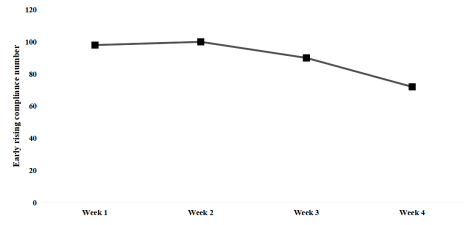
In the context of monetary incentives, among the 165 experimental participants who lacked a pre-existing habit of early rising and faced no intrinsic motivation to rise early, notable engagement patterns emerged, see
Figure 1. Specifically, 98 individuals qualified for the early rising task during the first week, with this number rising to 100 in the second week, slightly dipping to 90 in the third week, and finally stabilizing at 72 participants completing the task in the fourth week. This progression underscores the potent impact of monetary rewards as an external motivator in fostering the habit of early rising.
Figure 1. Changes in compliant numbers for the early rising task weekly.
It is clearly visible from
Figure 1 that a substantial proportion—ranging from 98 to 100 participants, equivalent to approximately 60% of the total—successfully adhered to the early rising schedule during the initial two weeks. This success demonstrates that economic incentives can effectively prompt short-term alterations in daily routines, particularly among those without a prior habit of rising early. This finding aligns with behavioral economic incentive theory, which underscores the pivotal role of external rewards in shaping and guiding human behavior. As the experiment progressed, the number of qualified participants declined to 90 (55% of the total) in the third week, suggesting a natural waning of the incentive effect and the emergence of a potential “fatigue phase” or “adaptation hurdle” associated with sustained behavioral change. Even so, 72 participants (44% of the total) completed the task in the fourth week, far surpassing the pre-experiment baseline of 0%. This comparison clearly highlights the efficacy of monetary incentives in promoting early rising.
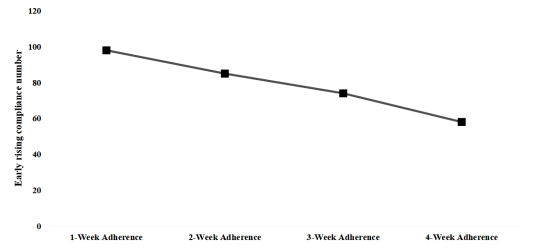
Refer to
Figure 2, regarding the consistency of participation, of the 98 participants who qualified in the first week, an impressive 85 (87%) continued their commitment into the second week. This indicates that monetary incentives not only initiated the habit of early rising but also contributed to maintaining this newly adopted behavior. This outcome supports the incentive theory perspective that external rewards can bolster behavioral sustainability. The count of consistent early risers dropped to 74 (75% of the first-week qualifiers) by the third week. Ultimately, 58 participants (59% of the first-week qualifiers or 35% of the total) qualified for all four weeks. While this proportion decreased compared to the initial week, it still underscores the beneficial influence of monetary incentives on long-term behavioral shifts.
Figure 2. Changes in compliant numbers for the early rising task over four weeks continuously.
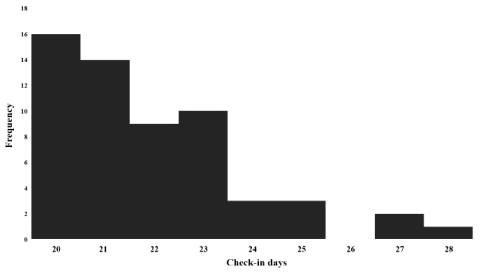
Furthermore, we examined the actual check-in records of these 58 participants who successfully completed the four-week early rising challenge (see
Figure 3). The criterion for success, as set out in the study, was to complete at least five early rising check-ins per week. Remarkably, these participants averaged 21.91 early rising days, with 42 exceeding 20 days and 9 achieving 24 days or more. This data underscores the stability and consistency of their early rising behavior throughout the experiment. Their performance offers invaluable practical insights, suggesting that with appropriate incentives and support, individuals can overcome challenges and achieve more enduring behavioral changes.
Figure 3. Distribution of early rising days among participants who completed the four-week challenge.
To inform school administrators and relevant managers in devising more scientific and effective incentive policies, the subsequent sections will delve into a comparative analysis of the incentive effects of various monetary reward systems in promoting early rising behavior.
3.3.2. Comparative Analysis
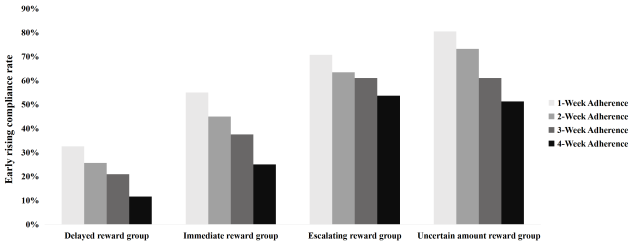
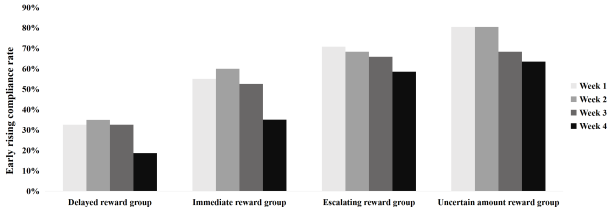
In our study, we randomly assigned 165 participants to four distinct groups: the immediate reward group (40 participants), the escalating reward group (41 participants), the delayed reward group (43 participants), and the uncertain amount reward group (41 participants). Due to the variation in group sizes, we selected the early rising compliance rate as our primary statistical indicator to objectively assess the effectiveness of various reward strategies in motivating early rising behavior. This indicator was defined as the proportion of participants in each group who met the early rising standard relative to the total number of participants in that respective group.
Figure 4 depicts the persistence of participants across the four reward groups during the four-week early rising task. Although the proportion of participants completing the task consistently decreased across all reward groups as the weeks progressed, notable differences in performance emerged among the groups. Specifically, the delayed reward group consistently demonstrated a lower compliance rate for sustained early rising compared to the other three groups over the four weeks. Among the groups receiving weekly rewards for early rising, the escalating reward group and the uncertain amount reward group outperformed the (fixed and certain amount) immediate reward group in motivating consistent early rising behavior. Notably, during the third and fourth weeks, when the compliance rates of other groups generally declined significantly, these two groups maintained higher compliance rates, indicating the stability of these strategies in motivating early rising behavior.
Figure 4. Comparison of early rising compliance rate among four groups over four weeks continuously.
To further evaluate and compare the weekly efficacy of diverse reward systems in motivating student participation, we conducted chi-square analyses. Alongside examining participants' four-week persistence, as illustrated in
Figure 4,
Figure 5 also focuses on the weekly compliance rates among the four monetary reward groups.
Figure 5. Comparison of early rising compliance rate among four groups weekly.
When comparing immediate and delayed rewards in the context of a four-week early rising challenge, the immediate reward group exhibited greater sustained effort. The data revealed that a significantly higher proportion of participants in the immediate reward group (25.00%) completed the entire four-week program compared to the delayed reward group (11.60%), with this difference approaching statistical significance (χ² = 2.50, p < 0.1). Weekly compliance rates for early rising further indicated that the positive effect of immediate rewards was particularly pronounced at the outset of the challenge. Specifically, in the first week, the compliance rate for the immediate reward group was significantly higher (55.00%) compared to the delayed reward group (32.60%) (χ² = 4.25, p < 0.05), suggesting that immediate rewards quickly motivated participants to adopt early rising behavior. This advantage persisted into the second week, with the immediate reward group maintaining a significantly higher compliance rate (60.00%) compared to the delayed reward group (34.90%) (χ² = 5.25, p < 0.05). Immediate rewards can be seen as a way to bridge the gap between the initial lack of intrinsic motivation and the establishment of a new habit. When students are faced with the challenge of early rising, which may initially be perceived as unpleasant or difficult, immediate rewards provide an external incentive that makes the behavior more appealing. This external push can help students overcome the initial resistance and start engaging in early rising. However, as the experiment progressed into the third and fourth weeks, the compliance rates for both groups declined, although the immediate reward group still maintained a slight advantage (Week 3: 52.50% vs. 32.60%; χ² = 3.38, p < 0.1; Week 4: 35.00% vs. 26.50%; χ² = 2.96, p < 0.1). This indicates that while immediate rewards are effective in the short term, they may not be sufficient to fully internalize the behavior into a long-term intrinsic habit. Once the external reward is no longer as salient or novel, students may lose motivation if they have not yet developed an intrinsic interest in early rising. In other words, immediate rewards may primarily serve as a catalyst for behavior initiation but may not effectively complement the development of long-term intrinsic habits on their own.
With the total reward amount remaining constant over the four weeks of consistent early rising, the escalating reward group received progressively increasing weekly rewards, in contrast to the (fixed) immediate reward group, which received an equal amount of 25 yuan each week. Thus, the immediate reward group and the escalating reward group essentially represented a comparison between fixed and escalating rewards. Firstly, in terms of sustained participation in the four-week early rising challenge, the proportion of participants who adhered to the early rising schedule for the entire four weeks was significantly higher in the escalating reward group (53.70%) compared to the fixed reward group (25.00%) (χ² = 6.96, p < 0.01). This suggests that the escalating reward mechanism was more effective in motivating long-term early rising habits. Furthermore, examining the weekly compliance rates, in the first three weeks (Week 1: 70.70% vs. 55.00%; χ² = 2.15, p = 0.11; Week 2: 68.30% vs. 60.00%; χ² = 0.61, p = 0.29; Week 3: 68.90% vs. 52.50%; χ² = 1.50, p = 0.16), although the escalating reward group had slightly higher compliance rates than the fixed reward group, the differences were not statistically significant. This may suggest that, in the initial stages of the task, both strategies employed immediate rewards to create external motivation for early rising, with comparable effects on promoting early rising behavior. In the fourth week, the compliance rate for the escalating reward group was 58.50%, significantly higher than that of the fixed reward group at 35.00% (χ² = 4.50, p < 0.05), demonstrating the long-term motivational effect of escalating rewards. The escalating nature of the rewards can be interpreted as a mechanism that gradually increases the students' perceived value of the behavior. As the rewards get larger over time, students may start to associate early rising not only with the initial external incentive but also with a sense of achievement and progress. This can potentially trigger the development of intrinsic motivation. When students see their efforts being recognized and rewarded in an increasing manner, they may begin to internalize the behavior and view early rising as a personally rewarding activity. In this sense, escalating rewards can complement the development of long-term intrinsic habits by providing a dynamic external incentive that aligns with the students' growing sense of accomplishment. As the rewards escalate, students may start to experience the intrinsic benefits of early rising, such as increased energy levels, better focus during the day, and a sense of self-discipline. These intrinsic benefits, combined with the escalating external rewards, can create a positive feedback loop that reinforces the behavior and helps it become a more ingrained habit.
Compared to the immediate reward group, which was informed of a fixed weekly reward of 25 yuan, the uncertain amount reward group had a total reward pool (= number of compliant participants × 25 yuan) that was dynamically calculated based on the number of compliant early risers each week. The specific earnings for each compliant participant were randomly distributed. This setup facilitated a direct comparison of the effects of certainty versus uncertainty in reward amounts. Firstly, in terms of sustained participation in the four-week early rising challenge, the proportion of participants who adhered to the early rising schedule for the entire four weeks was significantly higher in the uncertain amount reward group than in the certain amount reward group (51.20% vs. 25.00%; χ² = 5.89, p < 0.05). This highlights the more significant motivational effect of uncertain rewards in stimulating long-term behavioral adherence. Further analysis of weekly compliance rates revealed that the advantage of the uncertain amount reward group was particularly evident at the beginning of the task. The unpredictability of the reward amount creates a sense of anticipation and excitement, which can enhance the students' motivation in the short term to engage in the behavior. Specifically, in the first week, the compliance rate for the uncertain amount reward group was significantly higher at 80.50% compared to 55.00% for the certain amount reward group (χ² = 6.04, p < 0.05). In the second week, the compliance rate for the uncertain amount reward group, at 80.5%, was also significantly higher than that of the certain amount reward group at 60.00% (χ² = 4.08, p < 0.05). However, as the experiment progressed, the advantage of the uncertain amount reward group in terms of compliance rates diminished. By the third week, the compliance rates for the uncertain and certain amount reward groups were 68.30% and 52.50%, respectively (χ² = 2.11, p = 0.11). In the fourth week, the compliance rate for the uncertain amount reward group was 63.40%, significantly higher than that of the delayed reward group at 35.00% (χ² = 2.96, p < 0.01). This indicates that while the novelty of uncertain rewards can initially boost participation, it may not be as effective as escalating rewards in promoting the long-term internalization of the behavior. Nevertheless, uncertain amount rewards can still prevent students from becoming bored or complacent with a fixed reward structure, thus helping to sustain their motivation over time.
Finally, regarding the durability of monetary incentives for early rising, a duration of 20 days is considered qualified. None of the participants in the delayed reward group achieved more than 22 days of actual early rising. This result underscores the limitations of delayed rewards in sustaining long-term early rising behavior. In contrast, the performance of the immediate reward group (which featured fixed and certain amount incentives) was somewhat improved, with three participants achieving more than 22 days of early rising. The escalating reward and uncertain amount reward groups exhibited more robust performance. Among the 22 participants in the escalating reward group who completed the four-week challenge, six achieved more than 22 days of early rising, with one participant achieving all 28 days of early rising. Among the 21 participants in the uncertain amount reward group who completed the four-week challenge, ten achieved more than 22 days of early rising, with two participants reaching a maximum of 27 days. These results not only demonstrate the effectiveness of escalating and uncertain rewards in motivating early rising behavior but also indicate that these strategies significantly enhance participants' willingness and ability to maintain long-term early rising habits.
4. Conclusions and Recommendations
4.1. Empirical Findings on Incentive Mechanisms
Through a four-week experiment, this study delved into the impact of different monetary reward incentives on college students' early rising behavior, aiming to provide a scientific basis for promoting sustainable development among university students, particularly in fostering good living habits. The experimental results revealed that monetary incentives, as an external motivator, have a significant effect on the formation and maintenance of early rising behavior among university students. While monetary incentives can be effective external motivators that initiate and sustain behavior in the short term, their long-term effectiveness in fostering intrinsic habits depends on how they are designed and implemented. Immediate rewards can serve as a useful starting point for behavior change, but they need to be complemented by other strategies to promote the development of intrinsic motivation. Escalating rewards have the potential to bridge the gap between external incentives and intrinsic habits by providing a dynamic and rewarding experience that aligns with students' sense of progress and achievement. Uncertain rewards can add an element of excitement and engagement, which can help maintain motivation over time, but they may not be as effective in promoting the internalization of the behavior.
4.2. Theoretical Contributions to Behavioral Science
The theoretical contributions of this research are multifold. By integrating monetary incentives into higher education’s mental health and behavioral change frameworks, we offer a novel perspective on sustainable student development. This study equips university administrators and educators with a theoretically grounded approach to design evidence-based interventions that nurture early rising habits, thereby enhancing students’ holistic wellbeing. Furthermore, it enriches behavioral science by elucidating how reward temporality, structure, and certainty interact to shape long-term performance. Ultimately, these findings expand the application of behavioral economics in educational settings, providing empirical support for using incentive design principles to promote positive behavior change among students.
4.3. Practical Implications for Campus Policy
Practically, this study provides actionable insights for campus policy. University administrators can leverage these findings to develop more effective strategies for fostering early rising habits. For instance, establishing a reward pool funded by university funds, alumni donations, or corporate sponsorships could enable randomized distribution of bonuses to students who consistently use campus dining facilities before 7:00 a.m. each week. Additionally, implementing a cumulative bonus system with escalating rewards for daily check-ins may encourage sustained participation. Such interventions not only promote healthy routines but also enhance students’ physical and mental resilience through structured incentives.
In order to maximize the long-term effectiveness of monetary incentives in promoting early rising and other healthy habits among university students, it is important to consider a combination of different incentive strategies. For example, starting with immediate rewards to initiate behavior, followed by the introduction of escalating rewards to promote habit internalization, and incorporating elements of uncertainty to maintain motivation, could be a promising approach. Additionally, it is crucial to gradually reduce the reliance on external rewards as students start to develop intrinsic motivation for the behavior. This can be achieved by highlighting the intrinsic benefits of early rising, such as improved health, better academic performance, and a sense of self-discipline, and by providing opportunities for students to reflect on their progress and achievements.
4.4. Limitations and Future Research Directions
This study primarily focuses on monetary incentives as a means of promoting early rising. While this approach has shown positive and effective results, it may not be universally effective or suitable for all students. Some individuals may be more motivated by intrinsic personal goals, social support, or other non-financial factors. In the experimental design of this study, these factors are consciously controlled at a relatively low and uniform level to ensure that the external incentive effect is not disturbed. Another point worth mentioning is the relatively short duration of this study (four weeks). This short-term design limits our ability to fully assess the long-term sustainability of the observed behavioral changes and the effectiveness of the monetary incentive scheme over an extended period. It is possible that the initial positive effects may wane as time passes, and students' motivation to maintain an early rising habit could be influenced by factors that were not captured within this brief time frame. In addition, the sample in this study exhibited a certain degree of homogeneity. The participants were likely to share similar characteristics in terms of age, educational background, and possibly even lifestyle habits within the university context. This lack of diversity restricts the generalizability of the findings to a broader and more heterogeneous population of university students. Different student subgroups may respond differently to the monetary incentives due to variations in their cultural backgrounds, socioeconomic statuses, and personal preferences, which were not adequately represented in our current sample. Future studies should strive to include a more diverse range of participants, which will help ensure that the research findings can be generalized to a broader population of university students and contribute to the development of more inclusive and effective early rising programs.
When pursuing long-term behavioral adherence, a single external incentive may be insufficient to sustain individuals' continued participation and motivation. Therefore, future research can explore the effectiveness of these alternative incentive factors to build a more comprehensive and enduring incentive system. One promising avenue is to conduct studies that combine monetary and non-monetary incentives. For instance, incorporating elements of social recognition, such as public acknowledgment or peer-based rewards, alongside monetary rewards could potentially enhance students' intrinsic motivation and long-term commitment to early rising. Another direction is to explore digital interventions, such as gamification. By integrating game-like elements, such as points, badges, and leader boards, into early rising promotion programs, researchers can investigate whether these engaging and interactive approaches can effectively motivate students to adopt and maintain healthy morning habits. These digital tools could also offer personalized feedback and adaptive incentives based on individual progress, further enhancing their potential effectiveness.





 Share This Article
 Twitter
 Linked In
 Facebook
 Copy
Copy Download